Website Builder vs CMS vs Custom Development: What’s Actually Right for You?
10 min readTwohertz
If you run a café, restaurant, gym, salon, dive operation, or another growing business, you have probably faced the same decision:
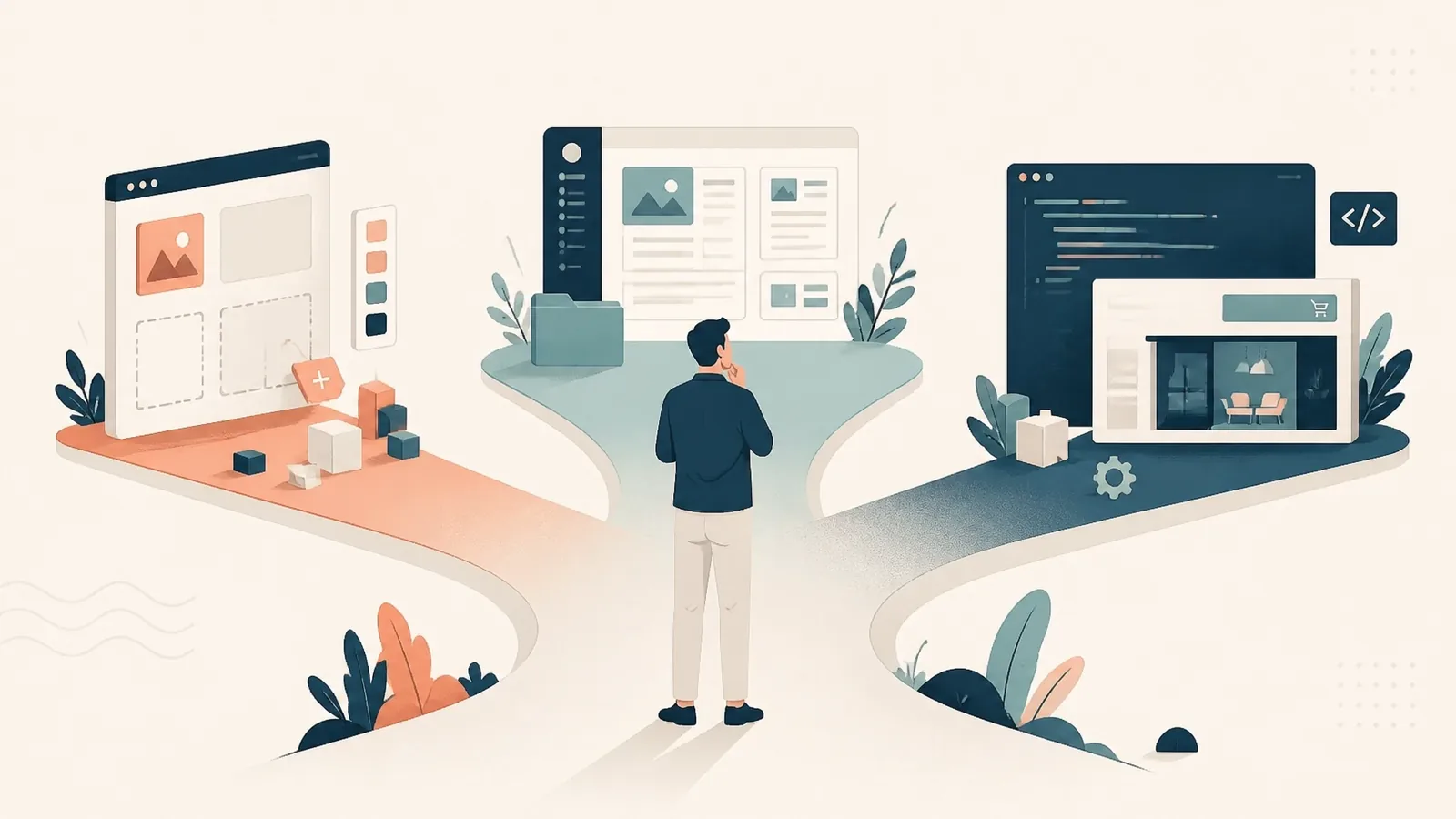
Should you use a website builder, install a CMS, or pay for custom development?
There is no universal answer. The right choice depends on your budget, how quickly you need to launch, how often you update content, and what you need your website to do.
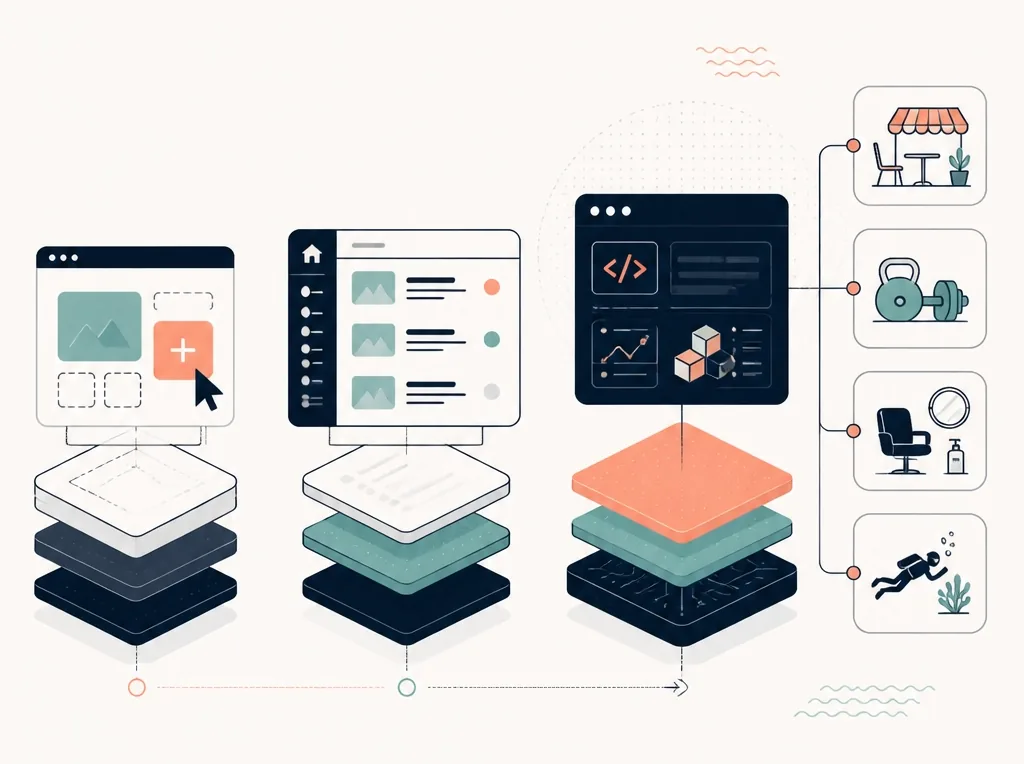
A website builder can be an excellent starting point. A CMS gives you more ownership and flexibility. Custom development costs more upfront, but it can give you a website and content system designed around the way your business actually works.
The important question is not simply, “Which option is cheapest?”
It is:
Which option will help your business win customers, manage content, and grow without creating problems later?
The three options in plain English
Website builder
A website builder is an all-in-one platform that usually includes hosting, templates, security, and a visual editor. You choose a design, add your content, and publish your website without needing to code.
Builders are useful when you need a straightforward site quickly. A small restaurant might use one for its menu, opening hours, location, and contact details. A personal trainer might use one for services and appointment enquiries.
The trade-off is that you are building inside someone else’s platform. You usually own your text, photos, and domain, but you may not own the underlying website structure or code.
CMS
A content management system, or CMS, lets you create and manage website content through an administration panel. WordPress is one well-known example, but there are many other CMS options.
With a CMS, you can usually control your hosting, database, website files, content types, plugins, and integrations. This makes it more flexible than a typical website builder.
However, that flexibility comes with responsibility. Someone needs to manage updates, backups, security, performance, and compatibility between themes and plugins.
Custom development
Custom development means building a website, web app, or CMS around your specific needs instead of starting with a fixed template.
A custom website can include a unique booking flow, member area, admin dashboard, customer database, payment integration, or content structure. It can also be designed so your team can update the site without relying on a developer for every small change.
Custom development is the most expensive option at the beginning, but it can be the best long-term choice when your website becomes a central part of your business.
Website builder vs CMS vs custom development
| Area | Website Builder | CMS | Custom Development |
|---|---|---|---|
| Launch speed | Fastest | Moderate | Depends on scope |
| Upfront cost | Lowest | Low to medium | Highest |
| Ease of use | Very easy | Moderate | Designed around your team |
| Design flexibility | Template-based | High with themes and development | Almost unlimited |
| SEO control | Basic to moderate | Strong | Strongest when built properly |
| Content ownership | Limited by platform | High | High |
| Maintenance | Mostly handled by provider | Your responsibility or your developer’s | Planned with your development partner |
| Scalability | Suitable for simple sites | Good for growing content | Best for complex systems |
| Integrations | Often limited to available apps | Broad plugin and API options | Built specifically for your workflow |
When a website builder is the right choice
A website builder may be the right option if:
- You need to launch in days or weeks.
- Your website is mainly informational.
- You have a small number of pages.
- You do not need complicated bookings or customer accounts.
- You want to manage the site yourself.
- Your current priority is simply being visible online.
For example, a new café may need a homepage, menu, gallery, location, and contact page. A website builder can cover those needs at a low initial cost.
The main advantage is convenience. Hosting, security, templates, and basic editing tools are usually included. You can make small changes without contacting a developer.
But convenience can become limiting as your business grows.
You may start adding separate apps for bookings, forms, email marketing, reviews, memberships, loyalty, and payments. Each app may have its own subscription, login, design limitations, and customer data.
At that point, your website may look like a collection of disconnected tools rather than one system.
When a CMS is the right choice
A CMS is often a good middle ground for a small business that wants more control without building everything from scratch.
It may be suitable if:
- You publish regular blog or marketing content.
- Your website will have many pages.
- Several people need to update content.
- You want more control over SEO.
- You need custom content types, such as menus, rooms, trips, classes, or services.
- You want to move your site between hosting providers.
- You are comfortable paying for hosting and technical maintenance.
A salon could use a CMS to manage services, team profiles, promotions, blog posts, and location pages. A dive operator could manage trips, itineraries, availability, reviews, and frequently changing rates.
A CMS gives you ownership of your content and database. It also provides more control over important SEO features, including page titles, URLs, redirects, structured data, internal links, and content organisation.
The weakness is that not every CMS setup is well managed. Too many plugins, a poorly chosen theme, or outdated software can make a website slow, insecure, and difficult to maintain.
The CMS itself is not the strategy. The way it is planned, built, and maintained matters just as much.
When custom development becomes the better option
Custom development becomes more attractive when your website is no longer just an online brochure.
You may be ready for a custom website or CMS if:
- Your website directly generates bookings or sales.
- You need a booking flow that matches your actual business process.
- Customers need accounts, memberships, or digital passes.
- Your team spends too much time copying information between systems.
- Your website needs to connect to other tools.
- Existing templates force you to change how your business works.
- You need to own both the customer experience and the content system.
- You are paying for multiple apps that do not work well together.
- Your website needs to support future growth.
This does not necessarily mean building a massive platform. Custom development can be focused and practical.
For a gym, it could mean a membership website with class schedules, customer accounts, and automated reminders. For a restaurant, it could mean a direct booking system connected to availability and customer follow-up. For a dive operator, it could mean a site where customers view live trips, choose cabins, upload documents, and receive booking confirmations.
That is the difference between a website that displays information and a website that helps run the business.
The biggest difference: ownership
Ownership is one of the most overlooked differences between these options.
With a website builder, you are usually renting access to a platform. If the provider changes its pricing, removes a feature, or limits exports, you have to work within those rules.
With a CMS or custom-built website, you can usually own the website files, database, content, and domain. You have more freedom to change hosting providers, add new functionality, or work with a different development team.
Ownership also applies to customer relationships.
If customers only contact you through a third-party platform, you may not have a useful way to reach them again. You win the transaction, but someone else may own the relationship.
A stronger system helps you capture permission-based customer data and use it responsibly for future communication. This is where the “wallet-loyalty” idea becomes valuable: the first purchase should not have to be the last interaction.
Twohertz built Atollcard, a loyalty platform that supports stamp cards, points, and cashback in Apple and Google Wallet. The goal is simple: help local businesses give customers a reason to return while creating a better way to communicate with them.
Why custom CMS development can be the right next step
Many small businesses do not need custom development on day one.
A builder may be the right starting point while you validate your idea. A standard CMS may be enough while your content and traffic are growing.
But when your business outgrows templates, custom CMS development can give you the best combination of flexibility and control.
You can have:
- A design that reflects your brand.
- A CMS your team can use without technical knowledge.
- Content types built around your services.
- SEO-friendly page structures.
- Faster, cleaner performance.
- Integrations that match your workflow.
- A clear ownership and maintenance plan.
For example, Ayo Raja Ampat Divers needed more than a standard marketing website. The project includes live trip schedules, rates, itineraries, a full booking flow, secure passport uploads, email notifications, and an admin CMS for managing trips, cabins, blog posts, reviews, and content sections.
That kind of system is difficult to manage well with a basic template and a collection of unrelated plugins.
A simple decision framework
Choose a website builder if you need a simple website quickly and your main goal is to establish an online presence.
Choose a CMS if content, SEO, and ownership matter, but your business can work within established features and integrations.
Choose custom development if your website is central to your revenue, needs unique workflows, or has outgrown templates and plugin-based solutions.
Before deciding, ask yourself:
- What must the website do today?
- What will it need to do in the next two years?
- Who will update the content?
- Do we own our customer data and website structure?
- Are we adding more tools because our current platform cannot do what we need?
- Will the website help us create repeat business, not just one-time visits?
The right website is a business asset
The cheapest website is not always the least expensive option. A low-cost platform can become costly when it creates vendor lock-in, limits your SEO, separates your customer data, or forces your team into manual work.
Likewise, custom development is not automatically better. It needs a clear purpose, sensible scope, and a team that understands your business.
The best choice is the one that supports your next stage of growth.
At Twohertz, we build websites, web apps, and customer systems for small businesses. That includes marketing websites, booking systems, admin dashboards, and custom CMS development services designed around how your team actually works.
We build software that wins customers. Then we help with the marketing that keeps them.
See more of our work or start a conversation on WhatsApp (opens in a new tab).
Frequently asked questions
Is a CMS better than a website builder?
A CMS offers more control, ownership, and SEO flexibility. A website builder is easier to launch and maintain. The better option depends on the complexity of your website and how much control you need.
Is custom development worth it for a small business?
It can be worth it when the website directly supports bookings, sales, memberships, customer retention, or daily operations. If you only need a few informational pages, a builder or standard CMS may be more practical.
Can a custom website include a CMS?
Yes. Custom development can include an admin CMS that allows your team to update pages, services, bookings, prices, blogs, reviews, and other content without editing code.
How do I know if my business has outgrown a website builder?
Common signs include needing too many third-party apps, struggling with SEO, manually copying customer information, being unable to create the pages or workflows you need, and paying more for add-ons every month.
What does a web development agency do?
A web development agency plans, designs, builds, launches, and maintains websites or web applications. The right agency can also help connect your website to bookings, payments, marketing, customer data, and internal business processes.